I've seen quite a bit of brand loyal flag waving on this issue lately. The letters published seem to lean towards the typical 'muscle car' designation the Camaro has done it's best to shake off for the last three decades, so perhaps this is to be expected. Bowtie guys would vote Camaro no matter what, Ford devotees would go Shelby, and this is also to be expected. Most test results were mixed, though. Pretty much everyone noted that the Chevy ruled the track and the Shelby owned the strip, and the toss up was which was a better street car. However, I've seen too much 'moah powah, moah betta' logic from folks who usually have more sense than this. The Camaro ZL1 should be properly noted for dancing with current 911s and GT-Rs, the Ford Mustang kind of being in the role of old flame who still thinks there's a chance at being anything but a fond memory.
Plus, the 'Chapman Is Always The Answer' crowd looks at the spec sheet, sees less weight and more power, and declares the winner sight unseen. I'm not going to claim that the Camaro isn't a few hundred pounds heavier and down nearly 100hp on the Shelby. But if we were talking, say, putting a V8 in an RX7, most of these geeks would be squawking about the front-rear balance, which, by the way, is better on the ZL1. Still, for some, the idea of 'Ford is the better Muscle Car, so it wins' seems without challenge.
Before we go further, let's get the inevitable comparison going.
The GT500 has bigger brakes, more power, more torque, less weight, higher redline, even somehow managed to post better highway mpg than the Chevy. And while I'm building a case for the Chevy as a better corner carver rather than 'pure musclecar,' as many publications wish to pigeonhole it as, the GT500 even manages to post hot laps faster than the ZL1 on tracks like Laguna Seca, which was always my 'real world car' test track on Gran Turismo. Damn if Shelby didn't pull a sucker punch on the ZL1, or so it would seem.
Back when all I had to test my auto ideas was a PS One and Gran Turismo 2, maybe 3, I had a system: I'd drive the car stock one lap around Laguna Seca to warm up and get used to the car's traits, then go for it. Whatever the car did, however I reacted, was how it was, but the track and conditions were consistent, the tires consistent, and the driver consistent. The data revealed how these cars reacted in a stock form to my driving style. It was enough to satisfy curiosity about how an 80's MR2 might differ from a Miata or an RX7, and considering that at the time I was merely wishing I could own a car like that, I was consigned to try and find the one I liked most in a stock form - as, if I acquired one, it would be awhile before I could afford to modify it, and I'd better like it as-is.
It's all quite idealized - the simulated car wasn't going to have 100k+ on the odometer, for instance, who knows what tires 'normal' corresponds to in the real world, etc. Hardly smoking gun type data.
The basics of one car's attributes vs another's was apparent, though - Civics didn't drive like MR2s which didn't drive like Vettes. It's hardly more than it is, but it's something, and Laguna Seca was picked because the course doesn't really let a car just spend time at 100+mph and 'exotics' don't have an advantage over a hotted-up hatchback in that regard. Which was fine by my standards, since when I started running that 'experiment' it was all I could do to keep a four speed 89 Civic Hatch running well enough to deliver pizza in. No sense in picking a track designed for cars I couldn't afford the keychain for.
As a matter of fact, for a minute in the 'modified' list, while my maxed out C5 Z06 beat a similarly modded R34 Skyline GT-R, both were beat by a heavily modded CRX Si-R - until I dialed the Vette back to 'only' 650ish hp, and the result was I was driving a 'slower' car faster, oddly enough. The 800hp version of the Z06 C5 was slower than the Si-R, but the 650hp version was faster.
As a matter of fact, for a minute in the 'modified' list, while my maxed out C5 Z06 beat a similarly modded R34 Skyline GT-R, both were beat by a heavily modded CRX Si-R - until I dialed the Vette back to 'only' 650ish hp, and the result was I was driving a 'slower' car faster, oddly enough. The 800hp version of the Z06 C5 was slower than the Si-R, but the 650hp version was faster.
Don't think this didn't occur to me when I owned my Si...I can dream! Sure, it would only involve a 260 horse Honda motor and a laundry list of cost-no-object mods to the chassis, suspension, and brakes, running race tires, and have almost no resale value, but I'd have my 'budget Corvette beater!' However, it's true that Laguna Seca is a pretty decent metric to throw at a car that will be seeing real roads in the real world, minus the fact that I'm sure the pavement is smooth and comparatively perfect - just the ticket if, say, you're running a live axle setup vs. an independent rear suspension that's designed to work on bumpy corners as well as fantasy-smooth ones.

So to see the GT500 post a .5 second faster lap on Motor Trend's recent comparison around Laguna Seca didn't exactly have me dancing in the aisles. But then, that's why there's all this 'writing' in the article. The Map Is Not The Territory, and the Spec Sheet is not the Car.
The GT500 could post the faster time for exactly one lap. Then it started slipping. First to just a little over the ZL1's time. Within three laps of the 2.2 mile course, the brakes gave up the ghost (despite being bigger) and the Camaro's times remained remarkably consistent, within 2/10ths of a second on each lap. The only time the Camaro would truly be shown up by the Shelby on a road course is if it were Time Attack, where the fastest lap wins. Regular track day at commonly held events? No question the ZL1 is going to be be on the podium, and the Ford - whose engineers still to this day don't seem to truly grasp the importance of braking - will be lucky to not be in the weeds. This scenario has pretty much repeated itself on every comparo I've seen so far.
Many have commented that this hearkens back to the 80's, when the Camaro was living up to it's promise as the Poor Man's Corvette and the Mustang was simply a cheap ass car with an over cammed motor and better power to weight. While the Camaro out handled, out braked, and was nearly as fast in a straight line as the Mustang 5.0, the 5.0 is remembered as the Stoplight King of the time. As some have commented, no one is going to follow you to the local autocross to see you whip the other guy's ass, but they'll watch the drag race happening before their eyes. Of course, the real answer to '80's Factory Stoplight King' is spelled G-N-X, but that's another debate entirely.

The Camaro hasn't been a mere 'Muscle Car' for a long time. Peter Egan wrote about how the Camaro and Mustang of the 80's were among cars the first you could take to a road course, beat on them all day, and drive them home available to the 'common man'. Racing was simply more involved before that and the cars being raced bore little resemblance to the stock example. More than a few 'import' fans have commented on the Camaro's handling abilities. When I first got to drive one, it was on the mountain roads going up to Big Bear Lake - hardly the local drag strip - and it made me want to try and buy a modern car as soon as possible. It was a V6 model and I could only imagine what an LS1/T56 equipped example was like.
The Gen IV F-Bodies took a gamble in going 'hardcore' - more aerodynamic, lower cg, more of a 'driver's car' than the merely hotted up coupe that is the muscle car archetype - and while it suffered in sales compared to the more conventional Mustang, it trounced it's performance handily, later V6 versions nipping at the heels of contemporary 4.6 GTs. The '90s V8 vs. V8 comparo was a foregone conclusion, and the Mustang was still the Fairmont based compromise it always was. Which, ironically, made it a better get-around car. F Body sales slumped, as the car wasn't appealing to non-gearheads and women, who flocked to the easier ingress and egress of the Mustang, and cared less about the crappier driving dynamics and less performance. Chevy screwed up by designing the car around the people who probably weren't going to buy the bulk of them. It's one of the factors in why you'll see dozens of M3s for every 'real exotic' on the road - one of them actually functions as a real car.
When the 2005 Mustang came out, the F body had been mothballed for years and had no competition. So Ford could get away with V8's that had competitive output with contemporary V6's and kind of bland retro styling that was better than the previous SN95 Stangs but hardly a street legal concept car like the Camaro is even in base V6 form. Pretty much every latter day Mustang upgrade, from the 300+ hp V6 to the 5.0l Coyote has been aimed at fighting one car - the Camaro.
Once the Camaro's production started up again, it came out and basically stole Ford's lunch in that segment, and has been doing it since. The Camaro is the car that saved GM and put it back in the black. As well it should, because while I applaud Ford's later Mustangs, GM set out to crush them from the outset. And essentially succeeded. In the hearts and minds of the uninterested passerby - non-car-person, import snob, what have you - only one of those cars is described as 'pure sex' over and over again. It's another arrow in a large quiver of world class design, go see how many Fords are mentioned vs. Chevy in 'most iconic car designs of all time' lists. No surprise here.
The Camaro has the same platform underneath as the CTS-V, aka the car with the best ride/handling compromise currently on offer according to much of the world's automotive press, according to almost everyone who reviews it. The Mustang is notable for being the last live axle passenger car available in the US, and to be fair, for doing a damn good job with it, chasing even the BMW M3 early on in many a comparison test. The new Mustang platform will be ditching said axle for a Camaro-competitive IRS setup. So it's not surprising that the Camaro has quite the handling and performance potential baked in to it's fundamental design vs the Mustang and has higher potential for performance regardless of engine output. One car has more power - the other can handle more.
 |
| So let me get this straight - it's more expensive, AND requires mods/optional equipment to be track ready? |
So, while the SS is definitely aimed at a more 'muscle car' buyer, and initially disappointed hardcore track fiends with it's understeer, such a thing is to be expected in that particular place in the lineup - after all, when people who get to drive a car with 400+ lb ft of torque abusing the rear contact patches, you don't want to give it 'evil' chassis tuning. Even the original MR2 and second gen CRX Si had to be tamed from their original specs, as the track-ready agressive rear end was spooking the common driver and did little good on a real roadway. And those were handling-centric designs not sold on horsepower.
The SS was even more so in need of a 'friendly' suspension tune - taming 400lb-ft and over 400hp simply isn't as easy as doing the same to what is basically an economy car motor lucky to have over 100hp to begin with. So understeer is there for the reason it is on most street cars - to keep idiots from killing themselves and the cars safe for Joe Average to drive, in lieu of suspension tuning only a small percentage of owners will be able to take advantage of. The previous owner of my CRX Si was a woman who only used it as a commuter and bought it because it was 'cute' and easy to park. She wasn't needing a rear toe setting that could lead to snap oversteer, I'm thinking.
The ZL1 and 1LE have come to the rescue, as people probably aren't going to go to 5th Gen forums and get word from people modifying the car, they want to see a factory example and what it can do. So bye bye understeer, hello balanced handling out of the box. While offering a safe, sane package that the true speed freak could modify for track readiness was the traditional American way and the way our home market worked for decades, it was time to show what a factory effort could accomplish. No one wants to compare modded vs stock cars anyway as it's a slippery slope, and not all mods are created equal.
The ZL1 and the regular SS may as well not even be the same car. And keep in mind, that while the GT500 gets a weight decrease AND power increase, the heavier/less powerful ZL1 can easily put down comparable lap times that the bench racer might be surprised by. On a relatively short course like Laguna Seca, the half second faster quarter mile time only equates to a slight lead for two laps, then trailing behind the Chevy. Those expecting a gigantic difference will be disappointed any time the order of the day isn't pure drag racing.
The ZL1 is a poor man's Supercar. It's a Budget Z06, if not the gonzo ZR1. Somewhat more mundane, yes, but the Ring Times tell all, my friend.
Yeah, what is the GT500's Ring Time, anyway? Seems like there's still not one posted. I know we were all waiting awhile back for Ford to get one done. Surely, the poor Ring has just been rained out the entire time. Every day. For six months or longer. "We'll get back to you on that" seems to be Ford's standard line on the GT500's Ring Time.
However, let's do some bench racing of our own here. If the GT500 starts losing brakes after 2.2 miles of Laguna Seca, enough to be slower around the 3rd lap of said course than the ZL1, how long could it possibly sustain any advantage on the Ring? Particularly with it's laughably old school shock setup and traction disadvantage on a famously shitty tarmac that Live Axles have a famously hard time dealing with, even when they're not trying to put down 600+hp. Particularly when the high speed corners that come up deadly fast require real brakes.
 |
| You're halfway through the 13 mile Green Hell when you come to this little beauty of a corner, but you're driving the GT500 and people in Poland can smell that your brake pads are cooked. What do you do, Ford fanboy, what do you do? |
While there's reams posted online about the supposed illegitimacy of Ring Times, the question begs asking: then why doesn't Ford just play along and do what the Romans do while in Rome...if the times are bullshit, then they can just bullshit a better time, so why not? And where is it? Yet, almost a year later, more than six months after publications were drooling over the time to compare to the ZL1, nothing. If Ford claims a time it's going to come up short and reveal the Mustang as the Muscle Car it is, while the ZL1 is still in pretty damn good company in that regard.
While the Ford guys get easy pickings on the spec sheet, and want to claim 'similar specs' to a ZR1, which is so far from reality I don't have to tear through it like bullets through tinfoil, let's just mention the obvious.
Ford doesn't have a Corvette to maintain.
In other words, the Corvette, much like the 911 in Porscheland, is the top dog. Does anyone honestly think that Chevy engineers somehow didn't see that the LS9's 638hp was up for the asking vs. the lower outputs for the LSA in the CTS-V and ZL1? The ZR1 engine stays in the ZR1, and with a frickin' Mustang and the Viper having higher outputs now, expect the new ZR1 to have even more. Not like it will be a challenge considering they found 20hp in the new engine revisions from the same displacement - the new LT1 will be 450hp to the LS3's 430. That's NA power. All Chevy has to do is turn the wick up with the supercharged variants, because every kid with a Honda D16 and a junkyard T3 knows more boost equals more power.
Much like 90's LS1 Camaros basically 'lost' 50hp to the Corvette through ECU tuning, the LSA's 'restriction' is political based, not engineering based. Quite obviously, if Chevy wished a 638hp ZL1 upon the world, we'd have one. And we just might, who knows, very soon. However, the LS9 and really the LSA are hardly gasping for breath even in the rarified performance realm they occupy. Considering that they're Fuel Injected, Supercharged, Small Block Chevy V8's running stock parts that beat race items for earlier generations of the same motor architecture, perhaps that's not surprising. But 585hp is still more than almost every production car ever made. And it's not like there aren't companies out there willing to sell you a smaller supercharger pulley.
 |
| SVT, meet SLP. GT500, meet nightmare. |
Before anyone mentions that the SLP ZL1 is priced in ZR1/Z06 territory, Lingenfelter's 630hp, 650hp, and 700hp upgrades are available, and priced right around what you'd save by not buying the GT500. For the same money, you can have just as much speed and power, if not more.
God Bless...the Aftermarket!
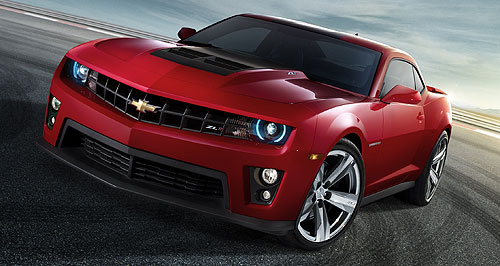
The Camaro ZL1 really is meant to silence the internet trolls and car snobs that think the Camaro is still some leaf sprung, log axled, over engined brute with no finesse. Aka, a 'Muscle Car'. It's 'at home on the track', the handling is 'unflappable', 'composed', 'confidence inspiring'. Everything a driver's car is supposed to be, only instead of some boring, conservative German coupe or a 'Hi-Ya!' styled Japanese coupe, you get a car that's pure concept car awesome and one of the few 'reboots' of old car designs that many think is superior to the car it copied. I can't choose myself - the original is the original, and the new version is what Chip Foose would build from scratch if he wanted a 'new Camaro with the old style' and Chevy wasn't already building it.
And, as someone who modifies cars, I can frankly always find a way to get more horsepower out of a given engine. It's much harder to tune a suspension and/or chassis, and I'd much rather have the factory ironing out the really hard wrinkles rather than worry about horsepower left on the table any schmo with a Jeg's catalog could come up with.
However, let's just put it this way. Like my Laguna Seca 'laboratory', the times tell a story when compared to each other.
So the question is: is the Camaro ZL1 a mere 'Muscle Car'? Forget the GT500 for a minute. Let's compare apples to kiwis for a minute, and see how the ZL1 stacks up against 'real' track cars.
I'm going to cherry pick a bit, just so it's not a bunch of Vette, Viper, 911 and GT-R times, but I'm going to highlight the Camaro ZL1's Ring Time vs. cars slightly faster and slightly slower than it. You tell me whether a car with this performance is a 'muscle car' and whether the GT500's price premium is warranted because of it being the 'better car'.
Ruf RT 12 - 7:35.0 / +6.27 secs
Lexus LFA - 7:38.85 / +2.42 secs
Lexus LFA - 7:38.85 / +2.42 secs
Mercedes SLR McLaren - 7:40.0 / +1.27 secs
Mercedes SLS AMG - 7:40.0 / +1.27 secs
Ford GT - 7:40.6 / +0.67 secs
Lamborghini Gallardo LP570-4 Superleggera- 7:40.76 / +0.51 secs
Porsche 911 Turbo S- 7:41.23 / +0.04 secs
Camaro ZL1 - 7:41.27 / 0.0 secs
'05 Corvette C6 Z06 - 7:42.99 / -1.72 secs
Audi R8 V10 - 7:44.0 / -2.73 secs
Pagani Zonda S - 7:44.0 / -2.73 secs
Lamborghini Gallardo Superleggera - 7:46.0 / - 4.73 secs
Ferrari 599 GTB Fiorano - 7:47.0 / -5.73 secs
BMW M3 GTS - 7.48.0 / -6.73 secs
Caterham R500 Superlight - 7.55.0 / -13.73 secs
See the full Ring Time list here.
Caterham R500 Superlight - 7.55.0 / -13.73 secs
See the full Ring Time list here.
I think the above speaks for itself. The Germans invented this 'ring nonsense', even if you don't put much stock in it, and it's their game. And Europe's. But look at that company the ZL1 is keeping. Not modified to the hilt, not in some 16 year old's imagination, and not after a bunch of 'dealer installed upgrades.'
"Real" Supercars every one. Even beats a 2009 Auto Bild time for a...09 Corvette ZR1. Drivers make a difference as does track times, and the ZL1's time with a GM hot shoe aboard certainly isn't close to the 7:19.63 2012 ZR1 time, it's pretty damn obvious that by any reasonable yardstick, the $60k ZL1 will show many, many cars often only seen on Gran Tursimo it's tail lights. On not only a 'real track', but the Green Hell.
Beating not just the Ford/Shelby, but many a Porsche, BMW, Ferrari, Lamborghini, Audi, and even Toyota's world record holding TMG EV P001, the world's fastest electric car around the Ring. Many hot shoes couldn't do better in a Nissan GT-R. Aka the car that was designed 'so your Grandmother could do 180mph.'
That one there on the bottom? Oh, I know it's quite a bit slower than the ZL1, by a much wider margin than the ZL1 is slower than the top listed Ruf. I just wanted to rub the Chapman Club's nose in it - the Heavy Chevy beats your 1115lb, 263 horse, Ultimate Chapman Mobile, by over 13 seconds. As per the Caterham website for the R500: "The Caterham Superlight R500 represents the ultimate expression of Colin Chapman's fundamentals."
It's also slower than a car that weighs ~3800lbs and wears a friggin' Bowtie. Ouch. Oh, and it only costs 10 Grand more than the Chevy. And assembly is required. That it's not quite in the same 'production' league as the Camaro need not be overemphasized.
Somewhere, Colin Chapman wants just a bit of his life back. For hookers, for some quality time with the kids, some bong rips, something because obviously some of his time spent to obsessively pursuing low mass could have been better spent. Not all of it, just some. I won't tell you what other late model Ring tuned Chevy has a faster time than a Lotus Exige S, because Chapman fans have had enough abuse for one article. But look it up, and cringe. Hint: it's wrong wheel drive.
These are just the production cars! Go here for a list of times of professionally prepped race cars. While I'm impressed by the cars the ZL1 leaves in it's wake, despite being street legal and emissions compliant for 2012 standards, let's just say I'm also mightily impressed by the Formula Ford progam! Most folks who've raced street and prepped race cars will tell you the former can almost never hang with the latter. The heavy, OHV, 'Muscle Car' ZL1 is doing just that. It's far from the top of the heap, granted, but not only older race cars, but even the 2008 Suzuki GSX-R 1000 liter bike was slower.
That's insane fast. No matter how you slice it. Making 3800lbs of steel move like a liter bike is no mean feat, even in a straight line.
Even a 600+ hp modified Toyota Supra posted a slower time by almost 8 seconds. That's the US Import Tuner Holy Grail sporting twice it's original output and tuned for the track.
Damn, it's nice being on this side of the fence. I mean, trust me, when I was 'full on import' in my mentality, I'd browbeat 'Mercan Iron loving folks half to death with my Chapmanisms. It proves that there really is no holding back a good idea, and vindicates GM for their steadfastness in pursuing the LS engine and the to-some 'archaic' layout of the Corvette's chassis. Apparently, the world's largest car company - despite the past, and despite Toyota's and VW's best to date attempts to unseat them from the King of the Hill position - knows a thing or two about making cars. Who woulda figured.
"OHVs and Leaf Springs, WTF?"
'Scuse me, you've literally got that backwards - not WTF, but FTW.
And, to be honest, the CTS/Camaro chassis needs to make zero excuses about it's engineering. It's competitive with Europe's best. Just ask the BMW M5 development team.
"Real" Supercars every one. Even beats a 2009 Auto Bild time for a...09 Corvette ZR1. Drivers make a difference as does track times, and the ZL1's time with a GM hot shoe aboard certainly isn't close to the 7:19.63 2012 ZR1 time, it's pretty damn obvious that by any reasonable yardstick, the $60k ZL1 will show many, many cars often only seen on Gran Tursimo it's tail lights. On not only a 'real track', but the Green Hell.
Beating not just the Ford/Shelby, but many a Porsche, BMW, Ferrari, Lamborghini, Audi, and even Toyota's world record holding TMG EV P001, the world's fastest electric car around the Ring. Many hot shoes couldn't do better in a Nissan GT-R. Aka the car that was designed 'so your Grandmother could do 180mph.'
 |
| Pictured: Slower than a 'POS' Camaro, costs nearly 3x as much. |
That one there on the bottom? Oh, I know it's quite a bit slower than the ZL1, by a much wider margin than the ZL1 is slower than the top listed Ruf. I just wanted to rub the Chapman Club's nose in it - the Heavy Chevy beats your 1115lb, 263 horse, Ultimate Chapman Mobile, by over 13 seconds. As per the Caterham website for the R500: "The Caterham Superlight R500 represents the ultimate expression of Colin Chapman's fundamentals."
It's also slower than a car that weighs ~3800lbs and wears a friggin' Bowtie. Ouch. Oh, and it only costs 10 Grand more than the Chevy. And assembly is required. That it's not quite in the same 'production' league as the Camaro need not be overemphasized.
Somewhere, Colin Chapman wants just a bit of his life back. For hookers, for some quality time with the kids, some bong rips, something because obviously some of his time spent to obsessively pursuing low mass could have been better spent. Not all of it, just some. I won't tell you what other late model Ring tuned Chevy has a faster time than a Lotus Exige S, because Chapman fans have had enough abuse for one article. But look it up, and cringe. Hint: it's wrong wheel drive.
These are just the production cars! Go here for a list of times of professionally prepped race cars. While I'm impressed by the cars the ZL1 leaves in it's wake, despite being street legal and emissions compliant for 2012 standards, let's just say I'm also mightily impressed by the Formula Ford progam! Most folks who've raced street and prepped race cars will tell you the former can almost never hang with the latter. The heavy, OHV, 'Muscle Car' ZL1 is doing just that. It's far from the top of the heap, granted, but not only older race cars, but even the 2008 Suzuki GSX-R 1000 liter bike was slower.
That's insane fast. No matter how you slice it. Making 3800lbs of steel move like a liter bike is no mean feat, even in a straight line.
Even a 600+ hp modified Toyota Supra posted a slower time by almost 8 seconds. That's the US Import Tuner Holy Grail sporting twice it's original output and tuned for the track.
Damn, it's nice being on this side of the fence. I mean, trust me, when I was 'full on import' in my mentality, I'd browbeat 'Mercan Iron loving folks half to death with my Chapmanisms. It proves that there really is no holding back a good idea, and vindicates GM for their steadfastness in pursuing the LS engine and the to-some 'archaic' layout of the Corvette's chassis. Apparently, the world's largest car company - despite the past, and despite Toyota's and VW's best to date attempts to unseat them from the King of the Hill position - knows a thing or two about making cars. Who woulda figured.
"OHVs and Leaf Springs, WTF?"
'Scuse me, you've literally got that backwards - not WTF, but FTW.
And, to be honest, the CTS/Camaro chassis needs to make zero excuses about it's engineering. It's competitive with Europe's best. Just ask the BMW M5 development team.
Looking down the list, Honda NSX-R NA1/NA2. Lancer Evolution X GSR. Porsche Panamera Turbo. Nissan Skyline GT-Rs in R33 and R34 trim. Mercedes CLK63 AMG Black Series. Vipers. Many a Corvette. All slower, and by huge margins - most wouldn't argue that even over a 13 mile course, losing to someone by 10 to 20 seconds hurts. In the adrenaline amped world inside the cockpit, in full 'athlete in the zone' Matrix consciousness, 10-20 seconds is an eternity. Practically enough for the Hunter S. Thompson 'be waiting for them with a beer in your hand already' move.
When your damnedest effort in the damnedest effort of some of the greatest car companies the world has to offer can't overcome such a defeat, it's got to irk you.
When the car you were chasing, that bested you by an eternity, is wearing a Bowtie, and isn't a Corvette, but a 'lowly' Camaro, it's got to be damn near infuriating. "We lost...to a Camaro?"
All the turbos, AWD, DOHCs, VTEC, four wheel steering, etc, all the carbon fiber and aluminum intensive structures. Beat by a gussied up rental car with a big engine. I'd say Chevy was David vs. Goliath here, but when you're the biggest car company on the planet, maybe Goliath isn't so easy to take down, after all.
I leave you to your cockamamie theories of how American Cars will never cut it in the realm of 'The Big Boys.' We don't need the Viper, Corvette, and GT to prove that anymore. Now we can even do it in the 'redneck chariot', the 'muscle car', that is the Camaro. Maybe we'll even do it in a Mustang one day :D
Speaking of the GT, Ford guys: not only does the ZL1 handily trounce your Shelby, it damn near beats your best ever effort at Supercar Greatness. 0.67 seconds of breathing room, and considering that GM probably won't take the supposed 'defeat' laying down, I wouldn't be surprised to be able to announce next year that Chevy has a Camaro faster than the fastest production track car Ford ever made.
Hell, Ford, if you can beat the ZL1 at it's own game, why not do so? If, say, it were .68 seconds faster around the Ring than the Chevy, you'd be able to claim you've not only built your most powerful car ever, but your fastest ever, too. Currently, you can only claim one of those. Oh, and the GT, as you may know, is no longer in production. So, without rehashing past glories, you got nada off of the drag strip.
For you forum dwelling Shelby trolls, keep dreaming about chasing down the ZR1. The GT500 won't match the ZL1's 7:41 time, and the ZR1 is nearly 22 seconds faster. Not if Santa and the Easter bunny brought you a magic engine tune.
Oh, and enjoy the quasi-victory while it lasts, boys - the 5.8l Coyote is an endangered species, as it's not going to be able to fit in the next gen Mustang. And if the ZR1 gets boosted past 638hp, then it doesn't take a genius to figure out what the Camaro will be doing with the Vette's leftovers. The Camaro obviously doesn't need to match the Shelby hp for hp to beat it, but if it did, or even came close, all it's going to do is widen the gap and show the Ford chassis for the well meaning dinosaur that it really is. The Chevy chassis isn't even at it's limit - it could easily stand more power. The Mustang has obviously already reach it's zenith in this generation, and it's back to the drawing board.
Speaking of drawing board, while Ford will likely dig deep to build a real competitor to the Heavy Chevy, know that Chevy is addressing the one 'drawback' of the car, which is it's size and weight. The CTS chassis will give way to the ultralight, BMW matching ATS platform. In a couple of years all of those LS swapped 3 series cars out there will be largely obsolete, as you'll be able to buy a new one with a factory warranty and zero miles. And frankly, keep pushing the envelope with the Boss - many of us are clamoring for a Z28 powered by an LS7. The ZL1 was a pleasant surprise and more than much of us in the F Body congregation hoped for.
Some things never change...and really, the winners are buyers of either car and the American automotive industry's perception in the world. While we're comparing one car to another there's little to say about the GT500 that's 'wrong'. Many want the more Muscle Car attributes because they're the same guys who used to rip the IRS out of the back of Cobras and swap the 8.8 back in, if not a 9 inch. Of course, well, for those guys, Chevy has the COPO, but hey, we'll keep it to stuff on the factory lot meant for the street, being daily drivable and putting out reasonable fuel economy and clean emissions.
While I've been used to seeing Corvettes battle it out with the best that the world has to offer, even I, as a guy raised in a Chevy household going back 2 generations before me - who's been poking around small block Chevies since he could pop the hood on Dad's Nova when he wasn't around to yell at me for going near the thing - even I was taken aback to see Toyota/Lexus's LFA merely eking out a less than 3 second advantage over such a 'humble' platform, and the other cars that it runs with, much less beats, is astounding. The 3 second advantage is huge but recall that the LFA is Toyota's second best effort ever, and is a car that costs over 6 times the Camaro's entry fee. Also, look over the list again - notice any BMWs that have posted a faster time than the ZL1?
Not.
One.
Here's a list of the manufacturers with posted faster ring times than the ZL1, just to see who's missing.
Porsche, Radical, Gumpert, Lexus, Dodge, Donkervoort, Chevy, Ford (GT), Nissan, Maserati, Pagani, Ferrari, Koenigsegg, Ruf, Lamborghini, Mercedes and McLaren. Notice quite a few 'better' brands of cars that 'make superior performance machines' aren't listed. I can't vouch for the list's completeness - seems there's a few McLarens missing, but that might be due to the qualifications for entry.
The fact that it can hang with that company without much exotica, that it's a real car underneath and not made out of Unobtainium and Unicorn Hide, is all the better. Who wants a Supercar you'll be afraid to use? The Chevy probably costs less than insurance policy on many of the cars mentioned here. Certainly less than a repair on, say, one of the Lambos, Ferraris, etc it leaves in it's wake. I'd say that the attainability, not the exclusivity, is the point here.
The Camaro hides an intriguing proposition - an American car that is quasi-affordable for the common guy that's Ring Ready and able to satisfy an itch that only being able to stare down most any car you meet on the street, under any conditions, straight road or spaghetti, and be able to hold your own, whether that car is a Ford or a Ferrari. While it won't trounce the current Corvettes it will certainly do so to the slightly older variants. Many a Viper as well. And it will do so right off the lot.
You'd have to save your pennies, natch, but it's also half the (significant) cost of cars that even begin to threaten it. The Z06 and ZR1 dust it, sure, but you could buy the Camaro and a nice CTS 3.6 Wagon for roughly the same money as the Z06, and you could make the CTS a CTS-V for the equivalence of a ZR1.
Hell, you could probably buy the Camaro and a decent house somewhere for that kind of money! Comparing it to cars other than the 'relative bargain' Porsches and GT-Rs, cars like the Pagani Zonda S, Laborgini Gallardo, Ferrari, or R8 V10 that it beats, and you could significantly upgrade your digs - and still pay cash. It won't be as much of an 'arrivers' car as the others, but hey, if that's your thing, you're probably looking up lease rates on the R8 or any other number of price no object cars to strut your financial stuff. While that's fine, you can save me the speech about how all the F1 derived technology on your exotic leaves the Flintstone Mobile Camaro in the dust - because in most cases you'd simply be wrong, and if you aren't, you're in rare company indeed.
We all know the Big Three can do muscle cars. We all know they can build a world class sports car faster than much of Italy's, Great Britain's, Japan's, and Germany's finest, for a price. But now, hell, our hi-po, 'cheap ass' Camaro can run with the best. Tell me why I'd be over at the BMW dealership again? Or, especially, why I'd be giving up the style of an American car for the 'Anime Geek's Wet Dream' look Japan decided to go with, after they figured out most of us weren't into well engineered jelly beans on wheels? American cars, once again, truly offer it all at a price the rest of the world still can't match, even though they've had decades to try and figure out a way to do so.
While some people have said 'but track performance isn't what a Muscle Car is about', they forgot that this is the Poor Man's Vette, and that the very same whiners and complainers spewed mountains of words complaining that said cars were Muscle Cars in the first place. Chevy, you can't win such minds over, but the rest of the world is watching, and some get it - "ZL1's Ring Time in 911 Territory" was one headline I caught while browsing, and is more to the point. Some people get it. Just like some people get why you build both the ATS and XTS, because some people want an 'old style Cadillac' and some want to hunt BMWs with a Wreath and Crest. Let Ford retain the Caveman Joe reputation, the typical attitude that American automakers make cars with more built in power than built in common sense.
It's not 1969, 79, 89, 99, or even '09 anymore. Chevies don't get compared to Dodges and Fords anymore. They get compared to the best in the world. They might not be for everyone, but if you have a bogey in mind you want to hunt with a GM product, they've got the hardware for you.

Oh well. I suppose there's always bitching about the interior or something...
Being a snob and parroting on about how 'American cars just aren't as good as imports' is as current as skin tight jeans and stupid 'louvered' sunglasses...oh wait, just because it's old hat, doesn't mean the clueless won't act like it's brand new, cutting edge, and oh-so-hip. Such is how the Confederacy of Dunces operates.
You can stick to old attitudes, or get with the times, and evolve into something better than you thought you could be. The Chevy Camaro ZL1 has done just that.
The Shelby GT500 is stuck in the past.
When your damnedest effort in the damnedest effort of some of the greatest car companies the world has to offer can't overcome such a defeat, it's got to irk you.
When the car you were chasing, that bested you by an eternity, is wearing a Bowtie, and isn't a Corvette, but a 'lowly' Camaro, it's got to be damn near infuriating. "We lost...to a Camaro?"
All the turbos, AWD, DOHCs, VTEC, four wheel steering, etc, all the carbon fiber and aluminum intensive structures. Beat by a gussied up rental car with a big engine. I'd say Chevy was David vs. Goliath here, but when you're the biggest car company on the planet, maybe Goliath isn't so easy to take down, after all.
I leave you to your cockamamie theories of how American Cars will never cut it in the realm of 'The Big Boys.' We don't need the Viper, Corvette, and GT to prove that anymore. Now we can even do it in the 'redneck chariot', the 'muscle car', that is the Camaro. Maybe we'll even do it in a Mustang one day :D
 |
| Miss a shift in 13 miles of Green Hell, and Ford's only true answer to the ZL1 gets passed. This Ford is better than the Camaro...slightly, maybe not for long, either... |
Speaking of the GT, Ford guys: not only does the ZL1 handily trounce your Shelby, it damn near beats your best ever effort at Supercar Greatness. 0.67 seconds of breathing room, and considering that GM probably won't take the supposed 'defeat' laying down, I wouldn't be surprised to be able to announce next year that Chevy has a Camaro faster than the fastest production track car Ford ever made.
Hell, Ford, if you can beat the ZL1 at it's own game, why not do so? If, say, it were .68 seconds faster around the Ring than the Chevy, you'd be able to claim you've not only built your most powerful car ever, but your fastest ever, too. Currently, you can only claim one of those. Oh, and the GT, as you may know, is no longer in production. So, without rehashing past glories, you got nada off of the drag strip.
For you forum dwelling Shelby trolls, keep dreaming about chasing down the ZR1. The GT500 won't match the ZL1's 7:41 time, and the ZR1 is nearly 22 seconds faster. Not if Santa and the Easter bunny brought you a magic engine tune.
Oh, and enjoy the quasi-victory while it lasts, boys - the 5.8l Coyote is an endangered species, as it's not going to be able to fit in the next gen Mustang. And if the ZR1 gets boosted past 638hp, then it doesn't take a genius to figure out what the Camaro will be doing with the Vette's leftovers. The Camaro obviously doesn't need to match the Shelby hp for hp to beat it, but if it did, or even came close, all it's going to do is widen the gap and show the Ford chassis for the well meaning dinosaur that it really is. The Chevy chassis isn't even at it's limit - it could easily stand more power. The Mustang has obviously already reach it's zenith in this generation, and it's back to the drawing board.
Speaking of drawing board, while Ford will likely dig deep to build a real competitor to the Heavy Chevy, know that Chevy is addressing the one 'drawback' of the car, which is it's size and weight. The CTS chassis will give way to the ultralight, BMW matching ATS platform. In a couple of years all of those LS swapped 3 series cars out there will be largely obsolete, as you'll be able to buy a new one with a factory warranty and zero miles. And frankly, keep pushing the envelope with the Boss - many of us are clamoring for a Z28 powered by an LS7. The ZL1 was a pleasant surprise and more than much of us in the F Body congregation hoped for.
Some things never change...and really, the winners are buyers of either car and the American automotive industry's perception in the world. While we're comparing one car to another there's little to say about the GT500 that's 'wrong'. Many want the more Muscle Car attributes because they're the same guys who used to rip the IRS out of the back of Cobras and swap the 8.8 back in, if not a 9 inch. Of course, well, for those guys, Chevy has the COPO, but hey, we'll keep it to stuff on the factory lot meant for the street, being daily drivable and putting out reasonable fuel economy and clean emissions.
While I've been used to seeing Corvettes battle it out with the best that the world has to offer, even I, as a guy raised in a Chevy household going back 2 generations before me - who's been poking around small block Chevies since he could pop the hood on Dad's Nova when he wasn't around to yell at me for going near the thing - even I was taken aback to see Toyota/Lexus's LFA merely eking out a less than 3 second advantage over such a 'humble' platform, and the other cars that it runs with, much less beats, is astounding. The 3 second advantage is huge but recall that the LFA is Toyota's second best effort ever, and is a car that costs over 6 times the Camaro's entry fee. Also, look over the list again - notice any BMWs that have posted a faster time than the ZL1?
Not.
One.
Here's a list of the manufacturers with posted faster ring times than the ZL1, just to see who's missing.
Porsche, Radical, Gumpert, Lexus, Dodge, Donkervoort, Chevy, Ford (GT), Nissan, Maserati, Pagani, Ferrari, Koenigsegg, Ruf, Lamborghini, Mercedes and McLaren. Notice quite a few 'better' brands of cars that 'make superior performance machines' aren't listed. I can't vouch for the list's completeness - seems there's a few McLarens missing, but that might be due to the qualifications for entry.
The fact that it can hang with that company without much exotica, that it's a real car underneath and not made out of Unobtainium and Unicorn Hide, is all the better. Who wants a Supercar you'll be afraid to use? The Chevy probably costs less than insurance policy on many of the cars mentioned here. Certainly less than a repair on, say, one of the Lambos, Ferraris, etc it leaves in it's wake. I'd say that the attainability, not the exclusivity, is the point here.
The Camaro hides an intriguing proposition - an American car that is quasi-affordable for the common guy that's Ring Ready and able to satisfy an itch that only being able to stare down most any car you meet on the street, under any conditions, straight road or spaghetti, and be able to hold your own, whether that car is a Ford or a Ferrari. While it won't trounce the current Corvettes it will certainly do so to the slightly older variants. Many a Viper as well. And it will do so right off the lot.
You'd have to save your pennies, natch, but it's also half the (significant) cost of cars that even begin to threaten it. The Z06 and ZR1 dust it, sure, but you could buy the Camaro and a nice CTS 3.6 Wagon for roughly the same money as the Z06, and you could make the CTS a CTS-V for the equivalence of a ZR1.
Hell, you could probably buy the Camaro and a decent house somewhere for that kind of money! Comparing it to cars other than the 'relative bargain' Porsches and GT-Rs, cars like the Pagani Zonda S, Laborgini Gallardo, Ferrari, or R8 V10 that it beats, and you could significantly upgrade your digs - and still pay cash. It won't be as much of an 'arrivers' car as the others, but hey, if that's your thing, you're probably looking up lease rates on the R8 or any other number of price no object cars to strut your financial stuff. While that's fine, you can save me the speech about how all the F1 derived technology on your exotic leaves the Flintstone Mobile Camaro in the dust - because in most cases you'd simply be wrong, and if you aren't, you're in rare company indeed.
We all know the Big Three can do muscle cars. We all know they can build a world class sports car faster than much of Italy's, Great Britain's, Japan's, and Germany's finest, for a price. But now, hell, our hi-po, 'cheap ass' Camaro can run with the best. Tell me why I'd be over at the BMW dealership again? Or, especially, why I'd be giving up the style of an American car for the 'Anime Geek's Wet Dream' look Japan decided to go with, after they figured out most of us weren't into well engineered jelly beans on wheels? American cars, once again, truly offer it all at a price the rest of the world still can't match, even though they've had decades to try and figure out a way to do so.
While some people have said 'but track performance isn't what a Muscle Car is about', they forgot that this is the Poor Man's Vette, and that the very same whiners and complainers spewed mountains of words complaining that said cars were Muscle Cars in the first place. Chevy, you can't win such minds over, but the rest of the world is watching, and some get it - "ZL1's Ring Time in 911 Territory" was one headline I caught while browsing, and is more to the point. Some people get it. Just like some people get why you build both the ATS and XTS, because some people want an 'old style Cadillac' and some want to hunt BMWs with a Wreath and Crest. Let Ford retain the Caveman Joe reputation, the typical attitude that American automakers make cars with more built in power than built in common sense.
It's not 1969, 79, 89, 99, or even '09 anymore. Chevies don't get compared to Dodges and Fords anymore. They get compared to the best in the world. They might not be for everyone, but if you have a bogey in mind you want to hunt with a GM product, they've got the hardware for you.
Oh well. I suppose there's always bitching about the interior or something...
Being a snob and parroting on about how 'American cars just aren't as good as imports' is as current as skin tight jeans and stupid 'louvered' sunglasses...oh wait, just because it's old hat, doesn't mean the clueless won't act like it's brand new, cutting edge, and oh-so-hip. Such is how the Confederacy of Dunces operates.
You can stick to old attitudes, or get with the times, and evolve into something better than you thought you could be. The Chevy Camaro ZL1 has done just that.
The Shelby GT500 is stuck in the past.