Tuesday, October 16, 2012

Project Buick Roadmaster, Part 7: Impala SS-ify Me!

Sorry for the wait. Not everyone has the option of being punctual whilst hot rodding the car they're sleeping in, and since the last post I've suffered the losses of my camera and laptop, and are only now finding a computer available to read my old memory card, etc. Thanks for waiting, all two of you.

There's a certain fear in hot rodding - the idea that you're going to buy Car X, mod it in various (and often expensive) ways, and for all of your effort, you're going to end up with what ends up being know as "Oh - THAT car."

Somehow, someone didn't see the local Cruise Night Crew guffawing at your 'Pintomino', no matter the rare 13" alloy wheels and other bits from the Mustang II bin. The car below? An examplar of taste compared to the 'Pinto-mino' my cousin ran around in while converting his 2.3l Mustang to the proper 5 liters. Missing? Oh, I don't know, the twin Cherry Bombs (complete with flappers) that were supposed to add a 'big rig' air to the little Pinto. No, it wasn't even a stick. I'll see if he'll send me some 'blackmail' photos later, but this isn't far away!
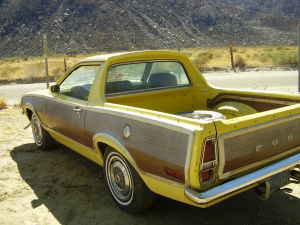

"Dude, it's all custom...it's gonna get me LAID, for SURE!!!"

Such was my personal nightmare; after being 're-dyed in the wool' as an Import Geek, I just wasn't capable of shutting the Bench Racer in my head up; "The chassis dates to 1958, it's not even a unibody, 4200lbs(!) of steel, no one but drag race guys seem to build them. You're going to end up with a medium fast in a straight line car with wheels that make it look like it should be faster that it is. Lame." Granted, I was more going for 'fastest RV I can afford to live out of', thus sheer capacity was more import than curb weight. But the nagging little small bore fanatic in me essentially voted for keeping it stock.

Yeah, right. Never seems to work out that way...

Basically, I'd been brow beaten to the effect that any car that didn't show 'Miata-ness' in it's stock configuration was simply beyond help, even though such luminous examples of import righteousness as the RX7, Supra, CRX and other Honda Si models, etc, rarely attain any kind of 'dominance' at the track unless modified in the first place. Don't bother sinking money into a pig, is the thought. And, of course, there's the "I got my info from [Blank] Performance Magazine" syndrome, where you'll rarely find worse information for the grassroots builder, even online. The schlubs online at least only have their own shortcomings to deal with - they're not actively trying to sell you automotive snake oil with inflated claims of power gains.

You know the one - "Yeah, this exhaust is worth 20hp on this car - granted, that was on a motor that had custom porting, custom ground cams, and oh yeah, it's turbocharged." Gains without said work? Take a guess, but I was warned by Mike Kojima himself online when I had my SE-R that the stock exhaust was fine up until ~180hp had been achieved - in other words, a more or less fully built NA motor or a Turbo version. Said 500 dollar cat back exhaust's actual worth to folks more interested in going fast than impressing 'net geeks they'll never meet? Almost nothing unless you've already exhausted pretty much every other modification.

So when I set out to modify the Roadie, I was skeptical. "Oh, this thing handles great now" never seemed to be backed up by skidpad tests and usually was uttered by a real Impala SS owner - in other words, guys with money to buy badges that match VIN numbers, not my game personally. Also, it tended to be uttered by folks more interested in quarter mile times than autocross dominance. "Handles great" to me sounded like it was coming from a guy who thought it was 'great' compared to the '65 Impala he used to have, or 'better than when I was driving to work on Big N Littles!'

However, I got my last big check in the mail, and the idea had been obsessing me to the point of idiocy anyway. I cashed the check, got online, and smashed headlong into a brick wall. Oops - no SS wheels for sale. Unlike last week, when I was checkless and three sets where going for ~350 bucks with tires.

To the forum! For some odd reason there was a set waaaaay out in Pomona that didn't show up in my search, but after posting a wanted ad over at http://www.impalassforum.com/, I ended up with a lead. I scored a good set of OE SS wheels, sans center caps, for 250.

Next I had to find tires, and turns out many forum members buy their 17" and up tires from as far away as Hawaii used a few exits down from where I stay. Atlantis Tire takes advantage of a local condition - that of having lots and lots of new BMWs and Porsches in the hands of owners that want to distinguish themselves from the 12 other BMW or Porsche owners currently bellied up to the bar at the Viper Room. Or wherever it is they hang out at. These are good sets of tires, inspected for flaws, for a decent price - 200 bucks for a set of Continental Conti-Sport CS2s in 245-45-17.

Around the corner to a local tire shop and I was in business! (For an extra 50 bucks.)


So, 500 bucks for a set of Impala SS wheels with Porsche tires. Not bad - all 'known quantities', no issues with fitment, bolt them on and go. I wasn't going to have such luck in the aftermarket. Besides which, though it's an 'obvious' mod, the ROH wheels that came stock on the SS are fairly iconic for a reason, are OE tough (nice when you're controlling two tons of steel driven by a lunatic), and are even easy to clean. They might not have the cache of other wheels, but think about it - transport yourself back to 93 and being, like a few folks, a little underwhelmed at the 'Shamu' styling of the Caprice. A little black paint, chopped police springs and these wheels later, you're standing in line, cash in hand.

Nice wheels.

My original plan was to get the rolling stock changed out for minimal cash. This involved selling the OE Buick wheels and tires for ~150 bucks, reducing my investment to 350 bucks. However, a forum member came out of the blue with an offer: "I've got a set of Hotchkis springs here with 8 miles on them. Wanna trade? Huh, huh?"

Let me look at the car with just the wheels on again...

Buick Roadmaster, now apparently with 4 wheel drive...


Dammit, man, you KNOW I wanna trade. Sigh...looks like I'm heading back to Peanut Butter Sandwich-ville faster than I thought...

A trip out to the desert to my secret underground garage facility and many knuck busting, ball joint splitting hours later...

Well, actually, two trips later. I spent the first trip out lowering just the front, which was less than ideal in a few ways - handling, one, and two, approaching driveways and dips, as the higher back end tipped the front even closer to the pavement.

After getting both ends on, we have this result...

Sweeeeeeeeet!!!


Not only is the stance pretty amazing, the handling is now up to par with my other modified vehicles of recent ownership. I'd regularly go after 35mph rated corners, and see how hard it was to double the posted limit. That was pretty hairy with the stock configuration as the 75 series sidewalls were just not cooperating. After the Hotchkis springs and SS wheels/Contisports went on, suddenly it just went through the corner. No drama, and we're talking a 4200lb car when it's got an empty trunk. I was running it with a quite full one. 

The results convinced me that with the SS wheels, good tires, and lowering springs (stock Impala SS items probably would be nearly as good with better ground clearance), the 'Grandpa' Buick is all of a sudden willing to play when the road gets twisty. I can now see why the SS's and other B bodies do so well in motor sports despite their gargantuan size. 

I think a mildly modded motor, SS wheels/tires, springs, shocks, and rear lower control arms are all this car really needs to get down. The potential was already evident even without 'appropriate' shocks (just used the stock items), not even an alignment. This is a good driver's car, and seeing SS's giving 'real' track hardware sweats at auto crosses doesn't seem weird to me at all anymore. 

Pimpest Ride on Skid Rose. Woo not included.


WARNING!!!!

Run these tires on a heavy car like this for a few months without taking care of the camber gain WILL result in having about an inch of steel belt looking at you from the inside edge of the tire. I pulled four different 1/4" shims out of the upper A arm mounts to put it 'eyeball' correct after seeing this, and it did mitigate the wear some, but still, message to the wise - if you LOWER a car, ALIGN it ASAP! Cheaper than a new (used) set of tires. 

****

I never got to finish this piece before my laptop crashed last year, so this isn't the promised wrap-up, just finishing what was to be the last installment on the car while I still owned it. 

Stay tuned for the wrap up and the story on the 240D buildup that came after - aka the 'Easiest Hot Rod In The World'. 

- CID


Small Engine, Big Efficiency? Why Bigger Can Be Better.

Small Engine, Big Efficiency? Why Bigger Can Be Better.

Or,

How to NOT waste your used car budget on something you'll hate.

As mentioned last post I've been crunching date looking to get the most out of my budget for my next car. While there are any number of tasty rides available for under 3k - I was looking about 6 months ago back when a lady was telling me she'd help me buy a 'cleaner' ride than my Benz Diesel, as she was apparently Compression Ignition Phobic - most of the truly cool ones are either too small (got a dog and crap, need space), too expensive to keep up, or too fuel thirsty. Some are all three.

Some, like the Family Truckster here, only come in
Metallic Pea.

BTW, real Craigslist find while on my search..


It started out years ago when I started looking for a 'fuel efficient midsize SUV'. I looked at various 4 cylinder models - Isuzu Troopers and the like - and came to a conclusion - mostly all a four offered at that level was less power than a six. While there were some fuel efficiency gains, we're still talking dismal mileage.

So how does one avoid having four cylinder passing power with eight cylinder mileage?


I've been using www.fueleconomy.gov extensively lately, and I can't recommend it enough for those of you buying a new or used car. Like a lot of people I hear 'four cylinder' and immediately think two things: 'low power' and '30mpg' or something along those lines. Sadly, though, there are a LOT of four cylinder cars and trucks out there that, depending on your driving style and whether you're mostly a city or highway driver, might not only be slower than your current ride, or the 'ride you want', but less efficient and economical as well. Not to mention, less capable...

For instance, last year I was getting a little bit of an 'enthusiast sales pitch' from a guy who likes the Toyota Previa minivans. They're pretty cool for what they are, bland styling for sure (I remember thinking of them as 'eggs on wheels' in junior high), but I was looking at something that would absolutely blend into modern traffic but be old enough to be cheap. Huge amount of room for music gear and/or living space. I saw a 2.2l Toyota four specified and thought it was a good match - it HAD to get better mileage than my 2 ton plus 5.7l V8 Buick, right?

Well, kinda. 

As you can see here, (http://fueleconomy.gov/feg/Find.do?action=sbs&id=11063&id=11404&id=27947&id=11432) the Previa gets 17 city mpg, 21 highway,  for a combined 18 mpg. 

The Roadie got 15mpg city, 23 highway, and 18 combined.

So if you had a 50/50 mix of highway and city driving the result is a wash. Go with what moves you - for me, that was 5.7 liters of roaring tailpipe music in a car that literally got me mistaken for a pimp - by a real pimp. 

If you're mostly driving in town, the Previa has a 2mpg edge, and if you're driving mostly highway, the same 2mpg edge goes to the Buick.

If I could easily swallow the monetary difference, the Previa looks outmatched by quite a bit. Would keep me from going bonkers thinking about engine swaps, though, because the Previa is pretty much foolproof in that regard - the factory that built it decided it was just easier to supercharge the stock motor. Makes a shadetree guy like me think of greener pastures...

You'd think a 5.7l, 260+hp American OHV V8 and a 2.2l DOHC Japanese I-4 would get wildly different results in the mileage department. I think it's best expressed as 'Overall Efficiency - Work Demanded = Actual Efficiency'. If the four didn't have to work so hard to move those 3500lbs of van, it would get better mileage. The V8 can lope around at lower rpm and do the same work in a relaxed manner. I don't doubt the LT1 would probably match or better the stock 2.2l powerplant if a swap were possible - after all, while the aerodynamics might suffer a bit, the Previa is 700lbs lighter too.

Reminds me of the old C5 Z06 vs BMW M3 reviews. I recall that the NA I-6 of the BMW put out less torque at peak than the LS6 did - at idle. Remember, torque = work, and out of horsepower or torque, the latter is the only one directly measured, rather than extrapolated by a formula (torque x RPM/5252 = HP). The less you have available, the higher the motor has to spin, and the more fuel consumed. 

Pictured: Efficiency. No, seriously...stop laughing!


It's a path to fast, and a path to efficient, apparently. Comparing more apples to apples motors, in a way, I recently got into a bit of a spat on YouTube with a Lexus fan dissing GM cars. Looking up the LFA specs, I noted that not only does the 3300lb, 550hp V10 'supercar' barely beat the ZL1 Camaro around the Nordschlieffe by 3 seconds over 13 miles, the 6.2l, Supercharged, 638hp LS9 in the ZR1 get's better mileage than the 550hp 4.8l Lexus V10. Not by a few, either - a base 6.2l Vette will turn in city mpg similar to the LFA's hwy mpg. 

Overall, the 'huge' engines, 6.2l, 7.0l, and 6.2SC, all turned in better mileage by about 5mpg average. 

(Vette Lineup VS Lexus LFA MPGs here - http://www.fueleconomy.gov/feg/Find.do?action=sbs&id=31326&id=31328&id=31327&id=31089. Left to Right - 'Base' Vette, Z06, ZR1, LFA)

Not bad considering the ZR1 is a third of the price of the 'base' LFA. Not a bad comparision, either, as both cars are obviously designed with high performance in mind and have similar curb weights. Drag coefficients are as follows: 'Base' Vette, 0.28, Z06 0.34, ZR1 0.36, and LFA 0.31. Even the 'porky' Camaro ZL1's average MPG is 16 - which is the LFA's highway rating. That's with a .35 cD and an extra 700 lbs or so to push around. (http://fueleconomy.gov/feg/Find.do?action=sbs&id=32161&id=31089)

Looks like a lot of engineering misapplied in a vain attempt to give a 'halo' effect to a bland product line. Or an example of how low end torque can be used for work, play, AND efficiency - but that's no news to diesel heads. 

Pictured: $375k worth of slower than a Vette and less
MPG than a Supercharged 6.2l Camaro.

Also pictured - why 'Hot Rod Black' should only applied to,
you know, hot rods.


But it also illustrates that, down here in the real world, not everything is cut and dried as it seems. 'Smaller motor = more efficiency' doesn't always compute. Not that one should just as blindly buy any old V8 engine and assume it'll be efficient for your particular use, either. 

So, for instance, if I were to truly put down roots here in Venice and want to stay, a Previa makes slightly better sense - who gets to cruise in overdrive in LA during anything but the wee morning hours? Almost entirely used in the city, over 10k miles, the Buick would consume 666 gallons (hee!) and the Previa only 588, a difference of 78 gallons and 351 dollars in a typical owner's year. That's about 30 bucks a month. Of course the same 2mpg difference in an all highway scenario would be the same, and for someone who could care less about the 30 bucks a month, well, I've got plenty of blog space devoted to the big B body. 

But, as I'm planning on going to New Orleans soon and have 2000 miles or so of highway driving, a Roadie would actually save me gas money, as well as being the cooler ride. When I lived in the Desert and you'd be in overdrive by the time you passed your neighbor's house, there would be no question - more power AND more MPG, please, all in a ride fit for a prince - or, at least, a pimp from Pomona...

Ok, so mine wasn't Magenta. Otherwise, I was a little embarrassed...

Oh, and I don't do decals, so NYAAH.

(From 'Bloom County' comic strip, published June 15th 1982)


Comparisons like this illustrate the finer details of choosing a ride, especially on a pretty limited budget. I, personally, wouldn't want to pay more or the same amount to get less of what I want out of my purchase. 

So at the time I also compared the Chevy Astro 2wd passenger van, a solid workhorse that's become practically legion as you literally see them all the time in LA. And I considered another Mercedes 300D Turbo in a pursuit of efficiency. Both were being weighed against the Previa and Roadmaster.

The Astro, despite a similar curb weight, almost identical transmission, and a 4.3l V6, gets worse mileage than the Buick. Without going into all the other reasons, this shit-canned the Astro pretty quickly in my eyes, though I'd consider one as a secondary vehicle. To be fair, the parts availability of the Astro is great (it's all S10/G Body parts and other standard GM RWD stuff), the Previa will never take to engine swaps, and Toyota's solution to having adequate power in a Previa, the S/C supercharged model, turns in similar MPG to an Astro. The Astro, however, would take to any number of engine swaps in search of more power or economy.

FWIW, the differences between the 4.3l V6 Astro, especially in MPFI trim (190hp, 260lb-ft), and the Previa LE S/C (160hp, 200lb-ft), considering the 1mpg difference city/hwy, are pretty much obvious. A low production high tech engine that was only made for one generation (plus the funky configuration, accessory drive, etc) vs. a 6 cylinder version of the venerated SBC in production for two decades -  are semi negligible - until one gets to the tow rating. The Astro? 5500lbs, same as the Roadie. The Previa? 3600lbs. If you want to tow, you know where to look. If goofy, one-time only arrangements and 'mid engine' minivans are your thing, well, best of luck with that. 

The Mercedes W123 body 300D was an interesting story as it's a 21mpg city, 23hwy, 22 combined car. So I'd gain quite a bit in town - more than most cars in the price segment that aren't 4 cylinder compacts with sub 2.0l engines - but no more highway mpg than my Buick. The city mpg was where I wasn't happy, and in that regard the 300D had better 'city manners', such as parking (GREAT turn radius/steering angle) and creamed the Big Bad Buford by 6mpg in the city. But... 

Then the gear head came into play.

"You know, the LT1 in the Buick's already been breathed on a bit, should be 285hp or more, probably stockish 330lb ft. The OM617a in the 300D has a mere 123hp and 170lb-ft, and while it can make more, it's a 2500 dollar Myna pump and a serious turbo upgrade away from any impressive numbers..."

Plus, yeah, I'm trading THIS for a Previa? Riiiight.....


That sealed it. I kept the Buick for another year after this initial run down. I still kind of regret selling it, to be honest - the car was a bonafide G-ride, and even a local character - an Inuit orphan who we all know as 'Pirate Darren' due to his ever-present leather Tri-Corner Hat, aka one of the least 'gangster' people I know - called my ride 'Gangster As Fuck'. Hard to show up a few days later in a car that looks like I knocked up a broad after hearing that a few dozen times...

So I kept the Buick for another year. I don't regret it, in a car guy way, in a 'practical guy' way I kinda do though. Really, the better option than both was the 300D and it's probably going to be my next ride, as these Benz built-to-a-standard-not-a-price-point tanks are still, in my opinion, the automotive deal of the century, and the 300D's average mpg is Accord/Altima like (http://fueleconomy.gov/feg/Find.do?action=sbs&id=27947&id=11108&id=11827), but I don't have to drive a frumpy mid 90's midsize FWD sedan. Granted, they're faster, and rated at better mpgs highway. But the 300D also has been reported reliably to get upper 20s highway if you're not driving 80 the whole way, too. 

Something to be said about getting into a Benz for the same price as an Accord and getting similar affordability and efficiency. Not to mention, this:


Choose wisely.

We're Back, And Twice As Annoying

Sadly, this was the last view I had...Now I know how the
driver in the other lane often felt.
Hello all,

Sorry for the delay but I was sans laptop for a good long time there, and while I could get my business done online via other computers, doing the whole thing was a bit much so I had to back-burner it.

Things have changed quite a bit. I'm no longer rocking the Roadmaster, having sold it for a small profit and moved onto an even bigger project, another Mercedes 240D manual trans. I'll do a wrap-up on the B-body soon and even see if I can dredge up the new owner's email for some updates.


I'm in an interesting space, waiting for the California Voluntary Advanced Vehicle Retirement program to get back to me. The 240D is quite beat - I tried to 'rescue' it from it's former life as an LA desert Mexican high-schooler's lowrider project, and kind of succeeded. I might be jinxing myself but I just think I picked a bad one this time and, considering that the state will give me 1500 bucks to junk it, I'd be better off getting something else with the proceeds rather than sink more of my limited funds into it.

I'm wading through Used Car Buying Circa 2012, seeing what's changed and what hasn't. I'm still 'urban camping' in my vehicle at the moment, so I can't go too gonzo on my next ride looking for G force induced thrills. But there are some pretty decent choices available in LA for 1500 bones and it's been interesting going through the elimination process to see what I'll end up with. Looking to see what I can get for the money, I've been investigating everything from cop cars (GM and Ford), small wagons, trucks, diesels, F-bodies and Supercharged Buicks.

So the Roadie all-rounder wasn't to be, and now I have a rat rodded 240D as my mobile palace/whip. More to come on that, the State of the Used Car Address, a wrap up on Grandpa's Revenge/Project Pig-Sticker and an introduction to Project Dead Meat, aka the doomed 240D. Stay tuned.

Tuesday, August 23, 2011

Project: Buick Roadmaster, Part Six - Stage One, "All The Mods 50 Bucks Will Buy", Part II

While turning the previously sedate Roadmaster into a brooding muscle sedan was a matter of taste (some would rather have the quiet than the power or sound I was going for), the LT1's intake system as delivered on the B-Bodies are chock full of ways to unlock power without letting the neighbors in on the fun. Most of the built-in restrictions to the factor system were aimed at drive-by noise standards and a competitive luxury market where the LT1's bad boy intake growl was a detriment rather than an attribute. So diving into the intake system offers up many places to make improvements without breaking the bank.

Porting The Stock Air Filter Housing


Cost: Free


The ported air box after 6k miles of desert travel - the Spectre
filter keeps the intake air very clean. Other cheap filters of the
type, even K&Ns, tend to let fine particulates through. On the
bottom and far left you can see where I've opened it up.


The stock air filter housing offers up opportunities to up flow rates without spending a lot of cash nor even any obvious visual cues. The front and driver's side walls of the lower portion of the box can be opened up for more flow, but avoid 'swiss cheesing' the box as you don't want to pull air directly off of the top of the PCU's heat sink, which, as you might have guessed, is there to slough off heat.

Also something to look at while the Dremel is out is porting the frame of the driver's side headlight. Anything to ensure air can move unimpeded to the factory airbox location.


Obviously, you don't want to compromise the integrity of the mount itself, but there was room for improvement here. Honestly, I'm sure most folks will skip this step; I don't for sure know if any actual effect is being produced here, but again, while the Dremel was out...though, take a look at the photo below and you can see the path to the stock airbox location behind the headlight.


The following 'porting' (whatever you might want to call it) might fall in the same category, might not. I cut two vents into the factory aero work under the driver's headlight, behind the lower part of the bumper cover. The idea is to 'scoop' air at speed and direct it to the same cavity that the above 'ports' feed.

Looking down from behind the DS headlight.
Of the two, I think this one is likely to be more effective. The good thing is that these, and the cold air source in the fender left by the factory, offer many paths for cold air to reach the the factory airbox location and thus make it less necessary for it to suck in hot engine compartment air.

The factory skirt and airflow at speed should direct more cool air
to the cavity that the factory airbox feeds from. 


"Home Plate" and "First Base" Removal


Cost: 10 bucks, if you haven't got a hockey puck lying around. 


This is a REAL redneck's car - who else but white people
would have a hockey puck just hanging around? ;-)
'Home Plate' and 'First Base' are the forum names for the factory intake silencers, the former being the big piece of plastic cockblocking your eye from all of that 'Vette Engine' visual goodness, the second the square-ish piece that goes from the MAF to the above pictured elbow in the factory setup.


Home plate is easy. I've used two items in the past - a peanut butter jar lid (glass jar, metal lid) and the classic hockey puck. I happened to have a hockey puck laying around when I got the car so that's what I went with. Ideally you'll position it inside the opening in the elbow with it off of the car, and try to make it as flush inside as possible (reducing interior turbulence/resistance) and then clamp it in place with the factory clamp.

First base, counterintuitively enough, is harder to fix. I went to Home Despot, bought two 3" 45˚ bends like the forum said, and it came to 8 bucks and tax. Just for the two bends, not the cement or the straight pipe needed to connect them, and there were no scrap pieces around at the time. If I'd have bought these, the "8 dollar intake" would have been closer to 20. I figured that the better investment of the two might be to just drop the Spectre in and call it a day, after all those panels are usually good for 5hp or so and it was only 20 bucks from Amazon.

Initially I taped the two bends together as seen in the first photo, left the MAF in the stock location, and drove it like that to New Orleans and back. It wasn't bad but it was a little shorter than ideal, I got it to fit by not fixing the air box to the stock mounts and just left it loose. It worked and since it was covered at the time by a sealed 'box' of windshield blocker (foil covered heat insulator) no one was the wiser.

Then I realized I could use the factory grommets and clamps to clamp the 'big' ends of the 45˚ bends to the MAF in the middle, which the factory wiring accommodates. The big ends will squeeze into the grommets, you put them over the MAF flange and clamp it all down. The bitch is that there's no flex in the ABS elbows so there's no clamping force on these. A good stomp of the gas and the engine rolls over, pulling them off. Not good.

So I have it covered up in this:

Duct Tape Of The GODS.
Gaff Tape's adhesive is very versatile, strong, yet doesn't leave the same residue duct tape does and is much, much stronger. It's used for, um, Gaffing - i.e. the hanging of lighting and/or sound rigs for live performances and filming. This tape suspends lighting assemblies weighing hundreds of pounds over the heads of paying customers and valuable talent the world over. To say it's 'trusted' is an understatement.

The adhesive is heat/friction activated, so when the engine compartment gets hot, the tape's adhesive wants to work stronger. Because we're dealing with a naturally aspirated engine, small leaks are pulled shut by the intake vacuum. If put together right, it's just as safe as clamps and hoses. Keep a roll in the trunk in case you get an SES light and have to repair on the roadside, but I haven't had this happen to me even though I've reconfigured the intake a few times and thus increased my chances of screwing something up.

In order to make this work, I also had to tape small end of the intake side elbow into the airbox. It'll squeeze into the factory hole with a little filing on the outside and a half round file can open up the ID of the air box a little. From the inside it'd look like this:


As you can see, while it's going to provide a sturdy connection to the air box, it could flow a bit better. This is one of the reasons I went to the "MAF in the Middle" configuration, as these sudden step downs in ID cause turbulence in the intake path. With the 'big ends' of the elbows in the grommets around the MAF flanges, those are more or less taken care of. The exit step opens out into a larger pipe, so no flow loss there really. I had the half round file out, so I took a few minutes and ended up with an intake pipe that a smooth transition:


While the ABS elbows aren't exactly 'car show' material there are advantages to it's use - workability of the material being one. Most forum members claim this mod is good for 5 hp, and while it might not prove to produce more power, I believe I have improved the standard design slightly here.

After getting everything just right, I sealed it all up with Gaff Tape and made sure there was enough tension created to keep the elbows on the MAF sensor. The SES light will come on if the seal between the MAF and Throttle Body is compromised, and if it's compromised downstream you'll have dirty air - but both connections are easy to seal up.

Spectre Drop In Panel Filter


Cost: 20 bucks

I topped off all of this with a Spectre drop in panel filter. These are usually regarded as 'cheap K&N knock offs', but K&N's specs haven't changed much since the 80s when they debuted. Spectre's filter has so far outperformed both the 'other cheap brands' and K&N in one regard; zero fine particulate in the intake so far. I used a new K&N cone filter on my SE-R's SR20DE and later found fine particulate in it, and that was on the comparatively less dusty east coast. So far, so good, and if nothing else, the Spectre and K&N are at least equivalent - which means I saved about 50% even if the Spectre is 'only as good' as the K&N setup.

The results are thus:


Adding It Up: The Sum Of It's Parts

So let's go down the list; throttle body bypass; home plate delete; first base delete; ported airbox and surrounds; better flowing air filter than stock. Let's just say, that when combined with each other, each is good for 5hp. I'd say my exhaust is good for better than that, but just for the sake of speculation:

   Stock engine:              260hp
+ TB bypass                    
+ Muff Delete                  
+ HP Delete
+ FB Delete
+ Air Filter                      25hp
------------------------------------------
=                                   285hp

That's the factory rating for the F Body LT1s. While many try to swap in a Camaro cam or this or that - much more work and expense even using used parts - in the pursuit of 'higher spec' horsepower could work, the F Body cam was designed to work with the F Body and Vette. The B-Body's cam was designed to work well with the extra half ton of weight that a Roadmaster Estate would be saddled with vs. the lighter sports cars. Even if the cam magically gave you the 25hp without changing anything else, you might not actually make the car 25hp faster. The torque curve is very important in any vehicle, but the more that vehicle needs that torque - i.e., the heavier it is or the more the application requires - the more important it becomes. Trading the luxury car type torque delivery for high end pull and power is a good idea in a 3500lb Vette or Camaro; in a 4200lb Roadmaster it's not a good idea.

For instance...

My former boss, Carl, had worked on a Hummer for Arnold Schwarzenegger at one point. He'd been driving a client's Lamborghini LM002 and happened to see Arnie's then über-rare Hummer in the parking lot and parked next to him. Arnie came out, he and Carl got to talking and then his experience at Callaway Turbo came up. Having wrenched on the famed Sledgehammer, Arnie thought he'd be ideal for modifying a Hummer for 400hp. Arnie loved the 6.2l (6.5l?) Detroit Diesel's off road performance, but on the highway the Hummer was a slug.

Carl built up the then-new LT1, 'the Vette motor' at the time, and over 50 grand later (keep in mind, the LT4 hadn't bowed yet and when you're pioneering mods on the 'new Vette motor', you pay out the nose for the privilege), he had the envy of the Hummer meet...up until he actually got out of the parking lot and went to the first part of the trail you had to crawl up.

Because getting an extra 100hp out of the LT1 caused the torque peak to move up, and even stock doubtless it was fairly stratospheric compared to the NA diesel V8, the Hummer was stuck on the first rock of the trail, and one hopes Arnie passed enough people on the way home to feel better about the experience.

The above mods should be good for the F-Body LT1's 285hp without changing the cam characteristics. Thus, not only is it the 'poor man's solution', it's also the smart man's. 50 bucks and a lazy weekend later the Roadmaster is something of a genuine, if mild, hot rod.

Chassis Horsepower! FREE!


Sure, straight line power is fine and all, but much like when I trained to fight, when you're already powerful, adding more power without some agility to be able to put it to good use is futile. The Roadmaster already has great acceleration from the factory for what it is, but the handling isn't quite as laudable.

Part of the reason for this is the tires; there's little to be done with those big balonies. However, fixing that's going to take some cash, and this is Cheapville we're living in for the time being.

The 9C1 Caprices have long been rumored to have a 'special frame' compared to the rest of the B-Body line; even the Impala SS didn't feel as buttoned down as the 9C1s did according to many owners of both models.

Googling around, I found out that that's because the factory, in their infinite wisdom - er, cheapness - decided that no B-Body cars besides the 9C1 would be delivered with all 14 body to frame mounts installed. The first 3 mounts on each side - from the radiator support to under the A pillar - are simply bolts that don't allow the flex to exceed 1". Jack the car up at the wrong spot and you can see the gap form between the frame and body.

So, you go and buy mounts and install them, right? Well, the pioneer of this mod/observation recommends replacing all of the mounts with better spec ones, driving the cost to about 75 bucks to do the whole car.

Mostly I'm concerned with the first mounts, which connect the frame to the radiator support and thus the rest of the front of the car. These are the front corners of the box; if they're not connected, the whole front is going to be sloppy. However, when I was getting a wild hair (hare? Neither one sounds pleasant) up my ass to do something about this, I was rather, um, broke. Seriously, unless I was going to be able to buy new mounts with food stamps, this just wasn't happening. Then something dawned upon me.

What's better than nothing to provide a mount to the body?

Anything. Anything at all.

So I remembered that friend had been using a hole saw on his drill to attempt to lighten a board my street performer friend uses for his show. I remembered the cast off 'discs' created by that. Hmm...

2" around, 3/4" thick. How thick were those recommended mounts again? 7/8"? Close enough. Given that the wood won't give as much as even hard durometer rubber, the 1/8" margin for error seems fine by me. I installed the pucks (after enlarging the center hole to fit over the bolts) and viola - instantly noticeable improvement in the front end's feel.

Yeah, yeah, Captain Hack, but how long is this shade-tree mod going to last in the real world?

The photo below was taken today, and those pucks have been down there for going on six months, and I've had some spirited runs on my chosen driving roads to put them to the test. A) They work, and B), they haven't failed yet. The real beauty of it? Even if they did, the car's configuring defaults to 'stock' by definition. Even a broken mount is probably better than air.

So there you go - new gauze air filter, low restriction intake system, hot rod exhaust, even a legit chassis mod - all for under 50 bucks. Car Craft, Grassroots Motorsport, and 24 Hours of Lemons, take note.

Total Cost Involved

Speaking of Car Craft, I like something they do - they pride themselves on actually publishing the cost of the mods they do. It keeps you objective, especially if you have other things going on in your life than impressing other insecure car guys with your ride's awesomeness. Besides, it's the name of the game here. So in that spirit...

Used LT1 Roadmaster                     $1000
2 Mobil One oil changes                        70
Spectre Air Filter                                    20
Rear diff fluid, gasket, LSD additive      25
2 3" ABS elbows, 45˚                             8
Exhaust clamps and adapters                 10
2 window rollers from HELP                14
__________________________________
Total                                                 $1147
Minus 1450 paid for accident            -1450
Total invested:                                   -$303

That, my friend, is modern hot rodding done right. While we can't all have a nearly 1500 dollar windfall land in our lap, it's a good reason to buy a car that's actually worth something, if only on the books. I am seriously curious as to how the $2012 Challenge rules would view this list. Even at 1147 bucks, I'd have over 800 dollars worth of mods to be done. I'd have to spend $303 to break even on the car at this point...how am I going to do that? Come back for Part 7, Where do we go from here? Or, Impala SS-ify Me!
            

Project: Buick Roadmaster, Part Five - Stage One, "All The Mods 50 Bucks Will Buy", Part I

I know that the last post had to be a bit barren and 'wordy' for most tastes, so let's just get this straight; though textually long, the next two posts boast lots of picture goodness and even two videos. This is the fun stuff - now that the maintenance is done, it's time to play.

Here, shiny shiny for you. Precioussssss....


The B-Body's LT1 has several areas that are known roadblocks to more power. The cam is one, the stock exhaust manifolds another. However, modifying either of those is costly (from the budget perspective, anyway) and of debatable legality where I now live. The cam's impact is a matter of choice, but as I've said, it's expensive to start messing with the exhaust manifolds, and you better get it right - the key to keeping the LT1 from going full on 'gas hog' is making sure the seal between the exhaust port and the O2 sensor(s) maintains it's integrity. Even then, it's a risk, though really it's not a Honda or Mustang or Camaro so roadside inspections shouldn't be anything I have to worry about. Sleepers just rock like that.

Still, there are several free to nearly so modifications one can perform when one is still stinging from the cash outlay that a new ride inevitably requires. They're a fine bridge to doing more serious mods and a great way to learn about your particular example while wrenching on it.

Throttle Body Bypass


Cost: FREE


If you look carefully you can see the black Gaff Tape Brand
Hose Abrasion Protector installed as well. 


This mod is supposedly good for about 5 horsepower and seems like a good way to avoid detonation as well. While the heated throttle body itself wouldn't cause those conditions, under moments of stress it could certainly add to the thermal loads that would. No sense in 'blazing' a path for cold air to reach your throttle body, only to have said throttle body hot enough to heat it up anyway.

There is a hose on the front side of the coolant tank shown above. This leads to the throttle body, where it passes through and comes out the other side. I'd have some pics, but it's been many months since I performed this mod. The exit hose then leads to a hard line running to the back of the engine along the valve cover.

The forums usually suggest merely disconnecting these hoses, buying a brass fitting, and connecting them to one another. However I didn't see any reason to do that and leave a lot - a LOT - of slack hose getting in the way. So I simply bent the end of the hard line up a few degrees, shortened the 'send' hose, and attached it to the hard line. Wrap some Gaff Tape around the hose where it might rub against the alternator bracket.


Muffler Delete


Cost: $10


The Muffler Delete is a now-classic beginner mod for these cars. The factory mufflers are good for about 211 cfm of flow each. The 2.25" exhaust pipes can flow ~400 cfm each. The factory mufflers are a restriction, but does that necessarily mean they cost power?

Thankfully you can estimate this easily on this engine for the reason that it's based on such a classic. Typically small block V8s of this size and tune are happy with a ~650cfm carburetor. 211 x 2 = 422cfm, which means yes, the factory mufflers are costing power.

This is handy to keep in mind when the punters over in the four cylinder/import field suggest that you absolutely, positively must go for the penultimate, whizz-bang, extreme modifications possible. The muffler you install simply has to be almost no restriction at all, or you're just not cool or something.

"This the biggest one you got? It's got to
match my giant NAWSSS tank"


However if you were to install a pair of mufflers that were 'somewhat restrictive' but were capable of 400 cfm of flow each, you'd have enough flow on tap to keep the engine happy, not to mention the fact that the 2.25" stock pipes are only capable of that flow rate anyway. So unless you're going to revamp the entire exhaust system, 'race' mufflers installed in lieu of the the stock pieces aren't going to be more effective than the 'merely adequate' pieces - and are thus a waste of money, especially on a mild street engine that's supposed to be powering a hopped up daily driver.

The accepted consensus at the Impala SS forum is that the stock resonators, however, are effectively no restriction at all and many keep them when modifying the exhaust to avoid the dreaded 'LT1 drone' on the highway. This drone happens with about 1/3 to 1/2 of the mufflers out there without resonators installed on the LT1.

Many B-Body enthusiasts have taken the above information and deduced that you could do far worse than paying a local shop about 50 bucks to have them bend up and weld in some pipes to replace the stock mufflers, leaving the over axle pipes and resonators in their stock location. This does work and keeps a factory look.

However, when I tried to get this done on the West Side (west sIIIIIIIIIIDDE!) of LA, though, most of the shops, used to dizzy customers with too much money, quoted me a few ridiculous numbers for what I wanted done, and I decided one inspired (stoned) afternoon to take matters into my own hands. Thus the CID Vicious Exhaust.

No one is paying me for my Photoshop skills, so...


I got two 2.25" adapters and two clamps at Pep Boys for 10 bucks. I reused the factory clamps on the back of the stock mufflers. I cut the resonators off of the over-axle pipes after removing them and 'simply' clamped the resonators onto the middle pipes of the factory system. In real life though I screwed up and didn't actually measure the stock exhaust. Up until the muffler exit on the stock system the ID is 2.25" as advertised, but the over-axle pipes and resonators are 2" ID. I ended up having to redneck it a little, which is to say I 'clamped the shit out of it' and fed the 2" pipe inside the 2.25" pipe to achieve a decent position and seal. There's a bit of leakage but not so much that you can tell curbside. Eventually I'll get proper 2.25" to 2" adapters on there, but in reality I'm probably going to order up a pair of Thrush glasspacks (perf-core and not louvered core, I've found out) in 2.5" size and mount them on the stock pipes a bit further up, and have turn outs fabbed up to exit in front of the rear wheels if I'm going to even screw with it. Unless I start running into clearance problems when I go to the lower profile wheels and tires I'm going to leave it alone until I can improve upon it significantly.

Honestly, I think this exhaust mod is all you need until you address the restriction at the beginning of the system, i.e. the exhaust manifolds themselves. If you're not running long tube headers I feel any investment in the exhaust beyond this is a waste of money. Oh, wait, I mean if you only care about horsepower and performance for dollar like I do - if you're a 'show car' type dude or an Impala SS owner I can understand your balking at this system. But if you care about performance for dollar spent, this 10 dollar exhaust system is hard to beat for flow, weight, materials used (everything aside from the Pep Boys parts are still stainless steel, which even some pricier aftermarket systems aren't), and even sound.

Some Impala SS guys hate this mod even when it's done with the welded in pipes - 'too much like a glasspack. Sounds like a redneck's car.'

But I'd have to agree with a random comment I saw on You Tube or one forum or another - "LT1 Roadmaster...a redneck's dream car."

So it's all six of one, half a dozen of the other if you ask me. Mostly, I get compliments on the sound, especially when I get on it. I'm biased, though. I've wanted to recapture the sound and aural sensation (shut up) of that header'd 327 screaming through glasspacks that powered my 'first car', the 65 Impala Convertible you don't know I used to drive because you didn't read my "Cars I've Known and Loved" post. Redneck? Well, we were in Florida at the time...

Again, if you've got more performance for less investment in either time to accomplish or money spent, let me know, but for me, this works. And yeah, I dig the sound. After years of sixes and fours, which are fun and great sounding in their own regard, I've wanted a V8's guttural growl under my foot for a long time. This mod gave me that in spades, and the 'glasspack' sound kind of goes with the 'modern day Led Sled' look.

Here's a little demonstration. Inside the car it's audible but not overbearing. I had to hold off at first to not blast a lady walking by with her dog, and you can't hear it when I turn up the radio but I got another throttle stab in. The exhaust, while 'too redneck' for the crowd that pops wood at the thought of billet anything, has a great burble at cruise, a terrific roar when the loud pedal is stabbed, and is easy to live with on the highway - which is more than many of the folks who've spent hundreds on their exhaust systems have said on the forums.


This post is pretty long as it is, and the intake mods from here out are pretty extensive. So I'm going to split this post into two and deal with all of the mods on the 'other end' of the motor that I've done, bringing the grand total to 45 bucks before taxes for mods that are theoretically good enough to at least equate the F-Body LT1's 285hp rating. If you're from LA and know a dyno owner that'd be cool with my making a run to prove this, I'm all ears, but until then...


Monday, August 22, 2011

Project: Buick Roadmaster, Part Four - Stage Zero, All Work and No Play

So now that I've pontificated enough on the merits of the Roadmaster, particularly the LT1 models made from 94-96, it's time to get down to business. What to do once you've got your Roadie home?

Stage Zero: The un-fun stuff


Stage Zero is the start of the build - the walk-around where you make sure you're not going to break anything due to negligence before going ahead with mods. It's pointless chasing after horsepower with mods if you haven't performed a tune-up or other routine maintenance.

My particular car had come in pretty damn fine condition; it was obviously used by older folks with a few extra bucks in their pockets, and thus was gently used and well maintained. I'm only the third owner on my particular example and the second owner barely used it at all, so I may as well have bought it straight from the Little Old Lady From Pasadena, though I shouldn't say that too loudly considering I found a Teamster pin in the tray cleaning it out. 3 body trunk, eh? *Gulp*...

Anyway, as you might imagine, with these cars only getting older (the newest would be 15 years old now), this is what you'd want to start out with. Certainly not the Gen I equipped TBI cars producing a mere 180hp that some were selling for 1.5x the price I paid, and in poorer condition to boot. Buyer beware; this car is a pretty desirable Ghetto/Trailer Park sled. Buy the car you want, not an endless 'project' just trying to update the car to a better factory spec, in my opinion. By not buying the one right down the block and waiting to pounce on a worthy example, I saved 500 bucks and gained 80hp without turning a wrench, not to mention the fact that this turkey was seriously dreaming; "the tranny's kinda going, but it's ok for now!" Yeah, sure bud, get right back to you on that.

As far as what the car DID need, the most glaring thing was a rear differential fluid change. The rear would chatter a bit making tight turns, especially after highway runs. This might have been why the previous owner was so 'motivated' to sell; he probably thought it needed a rear, but I'd already done my homework and knew that the fluid on a G80/Posi rear needs to be changed more often than an open diff would, and needs LSD additive to work properly. You also DON'T want synthetic fluid back here with the viscous-type limited slip unit; that's fine as it's even cheaper this way. This was very straightforward maintenance, if you don't could the stink gear oil produces. The rear is now quiet and the limited slip works like the factory intended.

The engine oil was ok but as I had a few bucks saved from not buying a turd to attempt polishing with, I decided to go with Mobil One 5w30 to extract extra efficiency and power, and clean up whatever accumulated sludge had built up in the last 17 years of operation. Before doing that, though, I decided to go with a Sea Foam treatment.

The Sea Foam additive/treatment is pretty well known in the many internet forums I've haunted and posted in over the years and is a fairly known quantity. I put some in the tank to clean the injectors, a litte in the oil, and the rest went into the intake elbow by loosening the hockey puck. You have to keep the opening just open enough to introduce the liquid; it'll stall if you just pry it open, though now I think you could do this really quite easily by removing the puck (or Home Plate if you haven't removed it yet) and unplugging the MAF, which causes it to run in Speed Density mode. The difference between the MAF signal and what the manifold pressure sensor sees is what I believe causes the stall. The LT1 can be run in either mode safely, as the early LT1s in F and Y bodies were Speed Density and the Mass Air sensor was apparently piggy backed onto this existing system. GM's bean counting sometimes works out in your favor instead of causing that rattle that you swear you'll be babbling about when they finally commit you...

The Sea Foam treatment can, in a motor with heavy deposits, cause so much temporary smoking that some users have had the fire department called while they were blowing all of the crap in their motor out the tailpipe. I've experienced this to varying degrees and was (pleasantly) surprised that the treatment produced almost no smoke. The plugs are a royal pain in the ass to change from what I've heard; since the factory change interval for them is pretty generous (I think 80k miles or so) and this vehicle was well maintained, and I'm seeing proper mileage, I've simply left them alone for now.

I'm still trying to figure out a doable long tube header solution that'll work with a roadside inspection; I'd simply return the factory manifolds and downpipes for inspection, as screwing with anything between the exhaust port and the cat in California requires CARB approval. There aren't any long tube headers that have a CARB EO#, and the shorties that do have been written off as more money than they're worth even by the Impala SS crowd that doesn't shy away from spending money on their ride. If my mileage stays the same, I'm holding out until I've come to a solution (or registered the car in a less draconian district) for the headers to change the plugs.

Pep Boys occasionally runs specials on Mobil One and other synthetics as 'oil change specials' with 5 quarts of oil and a Mobil One filter for ~$35. This is a pretty kick ass deal as it's cheaper than just the oil and let's face it, when you're peeling off nearly 50 bucks for an oil change, you're probably going to go with a cheap ass oil filter as a result on a budget build like this. I've managed to get both of the oil changes I've done so far with these specials.

The Mobil One formula is likely not the best synthetic on the shelf, but it's a known quantity and in case I ever find myself needing to top the motor up on the road - though I haven't needed to yet, as the LT1 simply refuses to burn more than about 1/3 a quart of oil through the 5k miles I ran the first oil change (mostly highway, to New Orleans from Los Angeles and back). While some folks are of the mind that LT1s were neither cheap enough to beat the SBC and not high tech enough to run with the LSX motors, I say they're quite a significant evolution of the Gen I motor. The wear on these motors - or lack thereof, rather - is simply amazing. Can't say that Gen I small blocks are known for being completely leakproof and burn almost zero oil over 5k miles of operation. For instance, I've read in Motor Trend and other magazines that the Porsche Boxster typically consumes a quart of oil between changes. GM engineers might have the Accounting Department Millstone hanging around their necks, but they still ain't no slouches.

I mostly had an easy time getting the car up to snuff; aside from the above, the transmission fluid was passable, other fluids were fine, the car hasn't had a problem with overheating at all so the stock thermostat is holding up well. I had 1.5 windows that rolled down, both in the back, now I'm up to 2.5. The B-Bodies where notorious for having window track clip problems and I've replaced them on the passenger side door, and will do the rear driver's side next. I have to figure out what's wrong with the driver's side window as it's currently doing nothing but clicking when I try to roll it down.

The car even came with 225-75-R15 tires that were damn near new. These are even a bit taller than the stock balonies and likely aren't helping my lateral grip or transitional grip, but have gotten me from point A to B flawlessly. Some better compound, lower profile tires are on the way. The shocks were all in good working order; really no complaints about any of the usual suspects when you're dealing with a 1000 dollar used car.

Anyway, this is about as 'exciting' as Stage Zero gets. It's so exciting, I don't really have any pics for you - google 'Roadmaster LT1 under hood', since you should still have a stock engine at this point. Although the Mobil One oil change usually does produce some extra power, this is all about laying the foundation for the mods to come. And the user consensus online is that you really don't feel the difference until the second oil change, as the pure base oils in the synthetic formulas get almost immediately contaminated by the sludge remaining in the engine after the previous oil was drained out. This is a good thing, though, because even in dirty-as-hell diesel engines like the OM617 in the classic diesel Benzes, using synthetic oils will leave the interior of your engine freer of deposits than Mr. Clean's polished noggin.

Next, we get to have some real fun, in Part Five: All The Mods Fifty Bucks Can Buy.

Ok...I couldn't leave you hanging without a picture. I just found out that the Canadian Prime Minister Jean Chretien preferred armored Buick Roadmasters during his time in office. Okay, I found out that via the Buick Roadmaster Wikipedia page, but only because I was checking to make sure my edits made it in...anyway, here's a sneak peek at a slightly more prestigious 94 Roadie than mine...

http://www.autonet.ca/autos/search/galleries/2011/03/25/pf-17754421.html

Curbside Car Porn: Whole Foods(tamp card) Edition

So I figured it was about time for another installment for the short attention span set. This time, I just tried out a little experiment; how many cars of note can I find in the Venice Whole Food(stamp Card) parking lot on a single visit? It absolutely didn't come out of a sheer lazy initiative to just get another one done... I thought it would illustrate the 'cartopia' that Los Angeles really is, I swear!

Which it should be, because living with the drivers of these fine examples is really for the birds...not these folks in particular, but chances are...
I actually saw this and remembered these rare coupes from
my brick fetish days. I'm almost certain I've never seen
one in person before today. It also reminded me:
'hey, don't I do a photo section in my auto blog?'
68 Conti Sucide Door Convertible - just so right...

Makes a handy pickup truck in this condition, too.
The owner was really nice. 

I was on my way to photograph the next car when this one
jumped out and said 'me first'.  Try to photograph a Ford and 

a Maserati gets in your way, that's just how it is...
There are so many of these things around here, it's ridiculous.
We literally have a dealership that basically only sells them,
in this condition, on Lincoln Blvd. 
All of the Maserati in the world isn't going to get you a
parking space here any quicker - I had to laugh,
this was probably the guy's fourth pass down a lane
looking for a spot - that I saw, at least.
Benzes like this one in this kind of condition are so common
here, I forget sometimes they're a rarer treat elsewhere. 
Love those classic Mercedes lines. 

V70R that I nearly waltzed right past. I almost wrote it off as a
'badge engineering' example until I saw the meats underneath.
Boring, if you think AWD and 245hp in a DL package
snooze worthy...

What's this? Well, the Maserati had finally found a spot; I had
a shot of 7 spots in a row that were filled with Bimmer, Bimmer,
Benz, Maserati, Bimmer, Benz, Bimmer all lined up; then a
security guard came over to shut my little photo session down.
Whole Paycheck doesn't like photos, so I thought I'd get one
of one of their funnier signs...No, sir, you'll be leaving my
'shrimp' quite alone, and I'd prefer if you didn't refer to it
as such...It's magnificent and frightens the womenfolk...